
In some places, we won’t know who won on election night. Maybe not this week. That’s a good sign. It means the system is doing exactly what it was built to do: count every legal vote carefully, then check the work.1
Here’s what happens between when you cast your ballot and January.
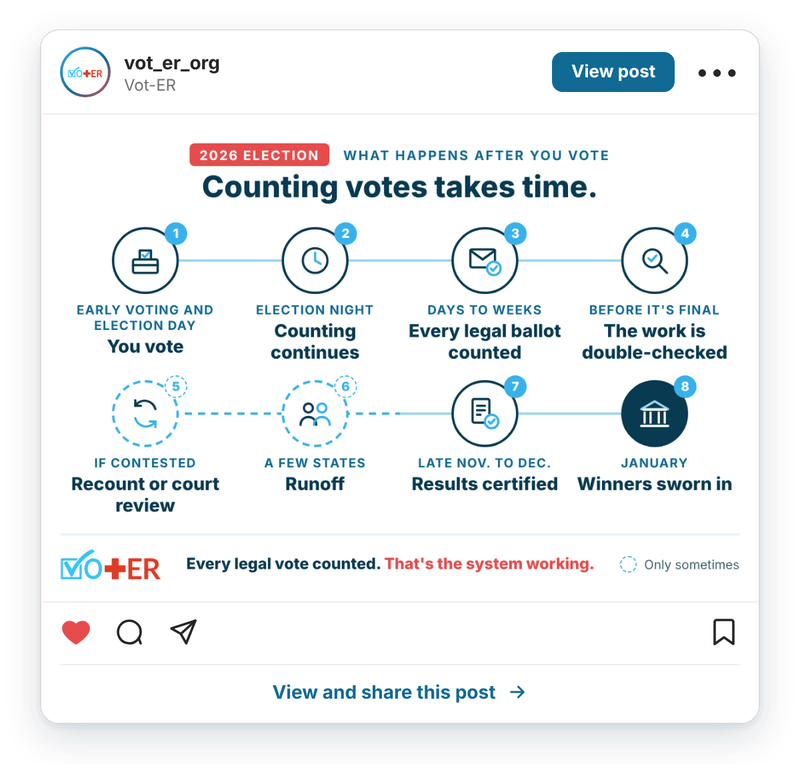
Certifying the official vote count takes time
Thousands of local election offices have their own equipment, paper trail, and people.2 And all of it is done by people: more than 770,000 poll workers served in 2024, most of them your neighbors.3 They make sure the number of voters checked in matches the number of ballots cast, and every state requires an audit after the election.4,5
This waiting period is when false information spreads, so the most useful thing you can do this week is simple:
The one thing that helps most
Pause before you amplify
Alarming claims about the count can spread before anyone can check them. If a post gives you pause, check sources before resharing. That includes not reposting a false claim just to debunk it.
Common concerns
Uncertainty is hard, and your patients trust you. A calm, nonpartisan “This is normal, and here’s why” from you does more than any headline. Here are five truths to debunk false claims.
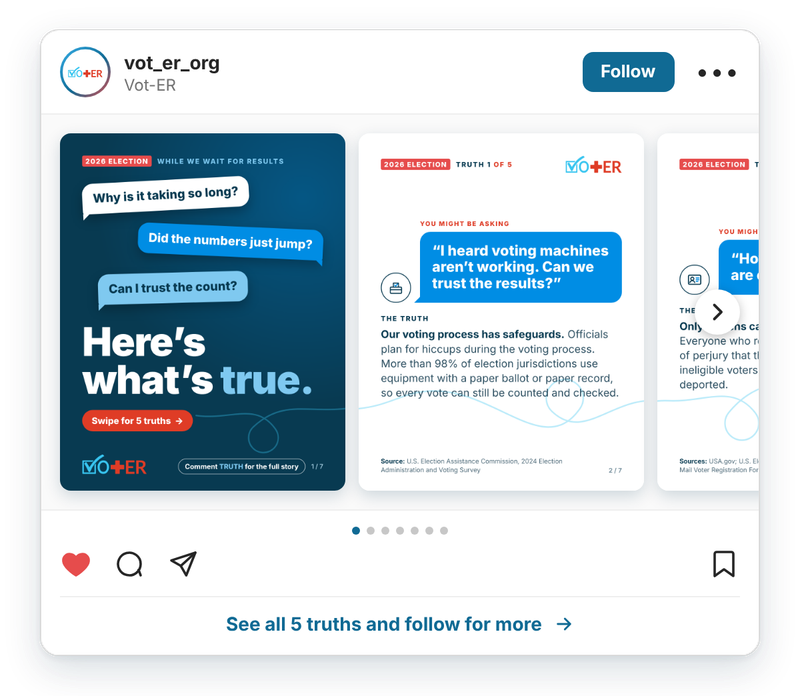
Tap any question to see the answer.
“I heard voting machines aren’t working. Can we trust the results?”
The truth
Officials plan for hiccups during the voting process. More than 98% of election jurisdictions use equipment with a paper ballot or paper record, so every vote can still be counted and checked.3
“How do we know voters are eligible?”
The truth
Only citizens can vote in federal elections.6 Everyone who registers swears under penalty of perjury that they’re a U.S. citizen, ineligible voters can be fined, imprisoned or deported.7
“Is voting by mail safe and secure?”
The truth
Americans have voted from a distance since Civil War soldiers cast ballots from the field in 1864.8 Today every state checks mail ballots before they’re counted, most by matching the voter’s signature or an ID number.9
“Why do the vote totals change so fast?”
The truth
Counting votes takes time. Once voter eligibility is confirmed, ballots are counted in batches by how and when they were cast, not by who they’re for: early in-person votes, mail ballots that came in before Election Day, ballots from drop boxes, Election Day votes, mail ballots that legally arrive after Election Day, provisional ballots. Each state counts them in its own order, and some can’t start processing mail ballots until Election Day, so totals shift as each batch is added.1,10 That is the expected schedule of legal votes.
“Why is there a lawsuit if the election is secure?”
The truth
Anyone can file a lawsuit. If a lawsuit is filed about the results of an election, judges decide based on evidence and state law, and each state sets its own deadline for certifying results.11 A court case can slow things down, but it doesn’t change how the votes are counted.
What you can do
Follow Vot-ER for trusted, nonpartisan information
We share helpful, nonpartisan information as election results are certified. Follow us, and share our “Counting takes time” post with anyone anxious about the count.
Ballot help: Voters can check the status of their ballot through their state election office. For trouble voting or a ballot flagged for a missing signature, Election Protection can help: 866-OUR-VOTE. Spanish: 888-VE-Y-VOTA. Asian languages: 888-API-VOTE. Arabic: 844-YALLA-US.
Manage stress: If the waiting is weighing on you or someone you care for, here are some suggestions on how to manage election stress.
Democracy rests on a simple promise: we settle our disagreements by counting, not by force. Counting carefully takes time, and that time is a sign the system is working.
Sign up for our emails
Get nonpartisan updates on the count, plus tools you can use with patients.
Sources
- PBS NewsHour, When Will We Know 2026 Midterm Election Results? It May Take Some Time, but That’s Normal, 2026
- Bipartisan Policy Center, Isolated issues are expected in any large election, but they reflect only a small portion of the tens of thousands of total voting locations
- U.S. Election Assistance Commission, 2024 Election Administration and Voting Survey, June 30, 2025
- U.S. Election Assistance Commission, Ballot Reconciliation: Election Day
- National Conference of State Legislatures, Every State Has Now Enacted a Post-Election Audit Law, April 30, 2026
- USA.gov, Who Can and Can’t Vote in U.S. Elections
- U.S. Election Assistance Commission, National Mail Voter Registration Form, oath in Box 9
- Smithsonian Magazine, The Debate Over Mail Voting Dates Back to the Civil War
- National Conference of State Legislatures, Table 14: How States Verify Voted Absentee/Mail Ballots
- National Conference of State Legislatures, Table 16: When Absentee/Mail Ballot Processing and Counting Can Begin
- National Conference of State Legislatures, State Canvass and Certification Deadlines Under State Law
Graphic sources: FairVote, An Analysis of Statewide Election Recounts, 2000 to 2023; Georgia.gov, General Election Runoff, December 1, 2026.